
Offshore Broker Licences Explained: What "Registered in SVG" Really Means
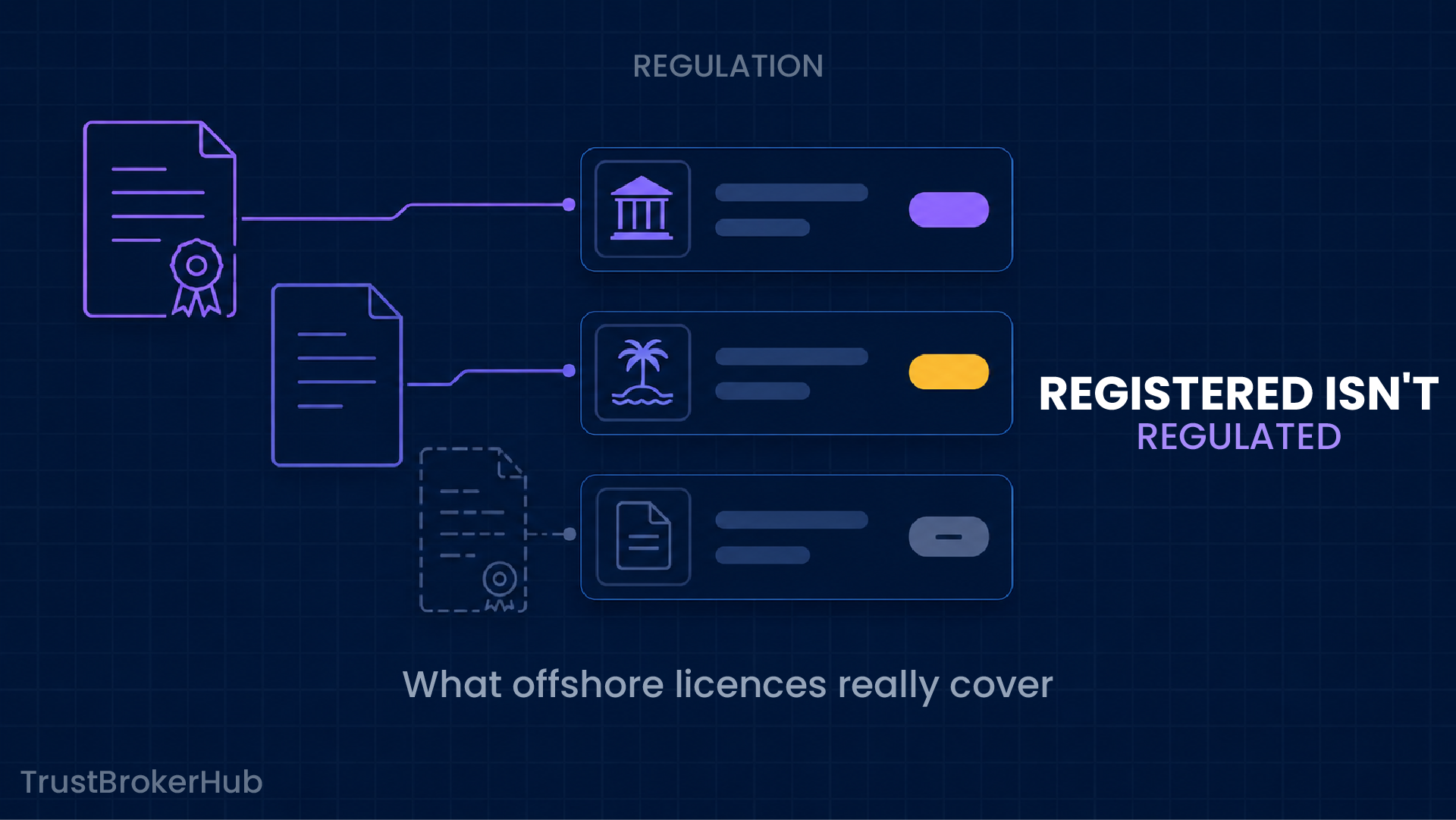
Most brokers that accept clients worldwide are not licensed in London or Sydney. They are registered somewhere small, and the word they use for it is chosen carefully. There is a real difference between a weak licence, a licence that does not cover forex, and a company registration dressed up as one.
Registration is not regulation
Incorporating a company is an administrative act. You pay a fee, file documents and receive a certificate with a number on it. It says a company exists. It says nothing about whether that company may hold your money, how it must hold it, or who is checking.
A financial services licence is different: it is granted after review, carries ongoing capital and conduct requirements, and can be taken away. When a broker's footer says "registered" rather than "licensed" or "authorised", that word choice is usually doing deliberate work.
Saint Vincent and the Grenadines
This is the most common address in retail forex, and it is the clearest example. The Financial Services Authority of Saint Vincent and the Grenadines does not license or supervise forex brokerage. It registers companies, and it has publicly stated that it does not regulate this activity — instructing firms to obtain regulation in the jurisdictions where they actually operate.
So an SVG "licence number" is a company number. There is no regulator behind it to complain to, no client money rules, no compensation scheme and no one auditing where deposits go.
Marshall Islands, and similar
The same pattern applies to several offshore company registries used by broker groups. What is being displayed is corporate registration, not financial supervision. If you cannot find a searchable financial services register for the jurisdiction that lists the firm and its permitted activities, there is nothing to verify.
The genuinely light-touch licences
Some offshore regulators do issue real securities dealer licences — Seychelles, Belize, Vanuatu and Mauritius among them. These are not fictional, and firms holding them have gone through an application process.
They are still a long way below tier one. In practice you should expect much lower capital requirements, limited or no compensation scheme, no ombudsman with binding powers, higher leverage with fewer client protections, and enforcement that is slow and rarely visible. A licence you can verify is meaningfully better than none. It is not the same as being covered by the FCA or ASIC.
Why brokers choose offshore
It is worth being fair about this. Offshore entities exist partly because tier-one leverage caps make certain trading styles impossible, and plenty of experienced traders choose them knowingly for that reason. Large, well-known groups run offshore arms alongside regulated ones.
The problem is not that offshore exists. It is that the trade-off is almost never disclosed at signup, and the trader who ends up there usually believes they are covered by the badge on the homepage.
How to read a broker's licensing claim
Work through it in this order. Which legal entity is named in your client agreement? Which jurisdiction licenses that specific entity? Is there a public register you can search yourself? Does the entry show permission to deal in investments and hold client money?
If any of those four questions has no answer, you are trading with an unsupervised company. Our broker directory lists the regulatory status we have been able to confirm for each firm.
Bottom line: the question is never where a broker is registered. It is which regulator you could actually complain to, and what that regulator has the power to make the firm do.