
What FCA Regulation Actually Protects You From (And What It Doesn't)
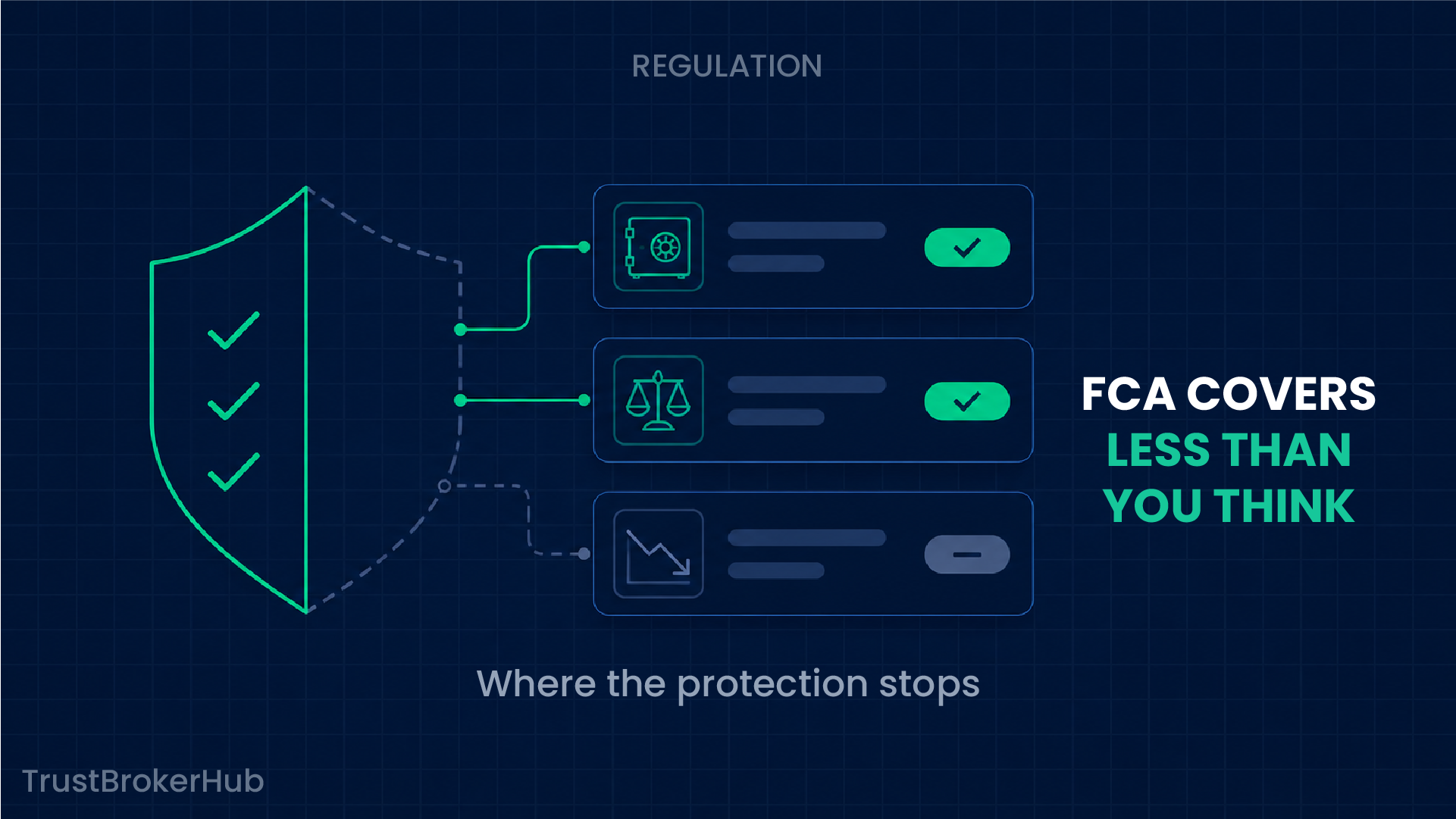
"FCA regulated" is the most quoted phrase in forex marketing and the least understood. It is a genuinely strong protection — and it protects you against a much narrower set of things than most traders assume. Knowing the boundary is what stops you being surprised later.
What the licence actually gives you
A firm authorised by the Financial Conduct Authority to hold retail client money operates under rules that are enforced, audited and occasionally used to shut firms down.
Client money segregation. Your funds sit in a separate account at a credit institution, not on the broker's own balance sheet.
The FSCS. If the firm fails and cannot return your money, the Financial Services Compensation Scheme covers protected claims up to £85,000 per person, per firm.
The Financial Ombudsman Service. A free, independent route to complain that can order the firm to pay redress, which matters far more than a support ticket.
Negative balance protection. A retail client cannot be left owing the broker money after a violent market move.
Leverage caps. Retail leverage is limited — 30:1 on major currency pairs, lower on more volatile instruments.
Rules on marketing. Deposit bonuses and trading inducements are not permitted for retail clients.
What it does not give you
The licence is about conduct and solvency. It is not a warranty on your trading.
Losses are not covered. The FSCS pays out when a firm fails owing you money, not when the market takes your account apart. Neither the FCA nor the ombudsman will compensate you for a trade that went badly, however aggressively the platform encouraged it.
It also does not vouch for pricing. A firm can be fully authorised and still charge spreads and swaps at the expensive end of the market. Regulation sets the floor for safety, not for value — for that you still need to compare the all-in cost.
The entity trick
This is where most traders lose the protection without noticing.
Large brands often run an FCA-authorised UK company alongside offshore entities in places like Saint Vincent, Seychelles or Belize. The website says "FCA regulated". The account-opening flow, depending on your country of residence, quietly assigns you to the offshore entity instead. Your money is then held by a company the FCA does not supervise, with no FSCS, no ombudsman, no leverage cap and no negative balance protection.
The only way to know which entity you are dealing with is to read the client agreement you are signing and check the company name against the register. If the name in the agreement is not the name on the FCA register, the FCA badge on the homepage is not yours.
How this compares elsewhere
The same structure repeats across the top-tier jurisdictions, with different numbers. CySEC firms in Cyprus fall under the Investor Compensation Fund, capped at €20,000. Australian clients under ASIC get comparable conduct rules and access to AFCA, with narrower compensation arrangements. The principle holds everywhere: the protection belongs to the licensed entity, not to the brand.
Bottom line: find the legal entity named in your client agreement, confirm it on the FCA register, and treat every badge that does not match as decoration.